Shanxi Jianing Forging adopts mature precision die forging processes, capable of producing gears, valve bodies, automotive swing arms, piston rods, and impeller die forgings. It offers high dimensional accuracy, and can be processed from carbon steel, stainless steel, and alloy steel, meeting the needs of multiple industries.
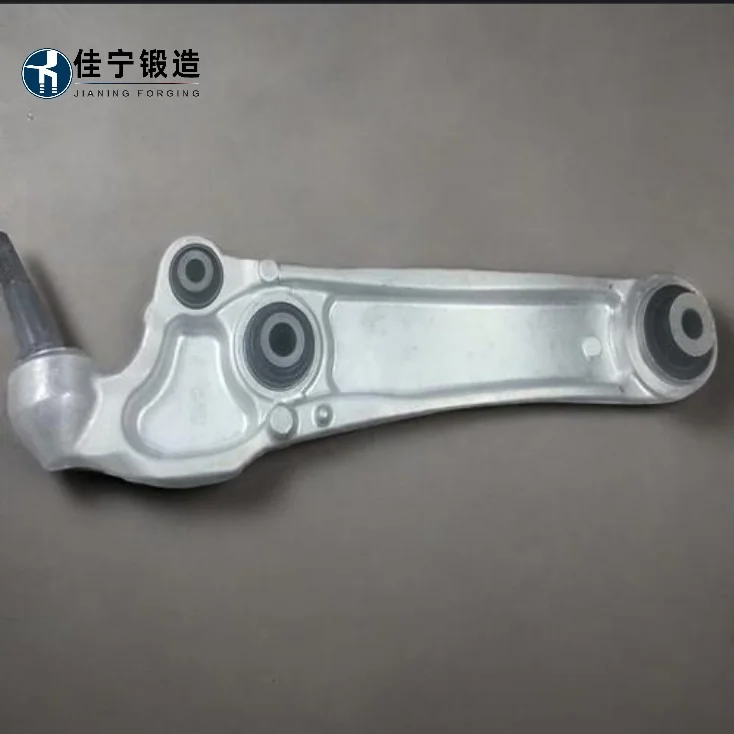
As a key load-bearing component of automotive suspension, the swing arm endures long-term impact and alternating loads. Ordinary cast or welded parts are prone to fatigue fracture, large dimensional deviations, and short service life. The swing arm manufactured using fine die forging processes increases material density and streamlined distribution from the source, enhancing fatigue resistance and facilitating continuous operation.
As a key load-bearing component of automotive suspension, the swing arm endures long-term impact and alternating loads. Ordinary cast or welded parts are prone to fatigue fracture, large dimensional deviations, and short service life. The swing arm manufactured using fine die forging processes increases material density and streamlined distribution from the source, enhancing fatigue resistance and facilitating continuous operation.
Automotive swing arm die forgings are formed from high-quality alloy steel through a fine forging process in one step, then undergo heat treatment and fine machining, achieving relatively high strength, high toughness, and excellent dimensional consistency. The products are widely used in passenger car and commercial vehicle chassis systems, effectively optimizing traditional casting or stamping-welded structures to meet the dual requirements of lightweight and reliability.
Selecting high-quality alloy steels (such as 40Cr, 42CrMo), strictly controlling chemical composition and post-forging quenching and tempering helps stabilize material properties.
Uses fine die forging technology for near-net forming, reducing subsequent processing allowance and improving material utilization.
Metal streamlines are continuously distributed along the part contour, and fatigue strength is superior to castings of the same specification.
Molds and processes achieve dimensional consistency in mass production, with individual tolerances controlled within ±0.2mm.
The surface has a high finish, and rust prevention treatments such as sandblasting, electrophoresis, or Dacro can be selected according to customer requirements.
This product is customized according to drawings; actual prices should be comprehensively evaluated based on specific models, material grades, annual demand, and surface treatment requirements. Please provide detailed drawings or technical parameters, and we will issue a customized quotation within 24 hours.
Free technical feasibility assessment and process advice are provided before customers place orders; The first batch of orders supports sample trial production; Bulk orders have dedicated project follow-up and production progress feedback; After product delivery, we provide comprehensive after-sales technical consultation and support returns or exchanges for quality issues caused by manufacturing issues.
| Parameter items | Indicator range |
|---|---|
| Common materials | 40Cr / 42CrMo / 30Mn2 (other grades can be customized) |
| Unit weight | 0.3 kg – 6.0 kg |
| Dimensional tolerances | Standard grade±0.3 mm; Fine grade± 0.15 mm |
| Surface treatment | Sandblasting / Electrophoresis / Dacro / Phosphating (optional) |
| Mechanical properties | Tensile strength≥ 800 MPa; Yield strength≥ 600 MPa (using 42CrMo as an example) |
| Production cycle | Mold making takes 15–20 days; Batch production cycle is 7–10 days |