Shanxi Jianing Forging has gathered real-world cases of wind power flange rings, ring gears, bearing rings, roller rings, and other ring landings, with a complete range of finished forging products for carbon steel, stainless steel, and alloy rings, providing reference for product selection and non-standard solutions.
In Liuzhou, Guangxi, a company specializing in wind power accessories has long faced the problem of unstable quality of ring forgings. The annular forgings purchased by the factory often exhibit large dimensional deviations and uneven internal structures during subsequent processing, leading to a decline in finished product yield and affecting delivery cycles. To improve this situation, the factory sought cooperation with professional forging suppliers and ultimately chose the customized ring forging solution provided by Jianing Forging.
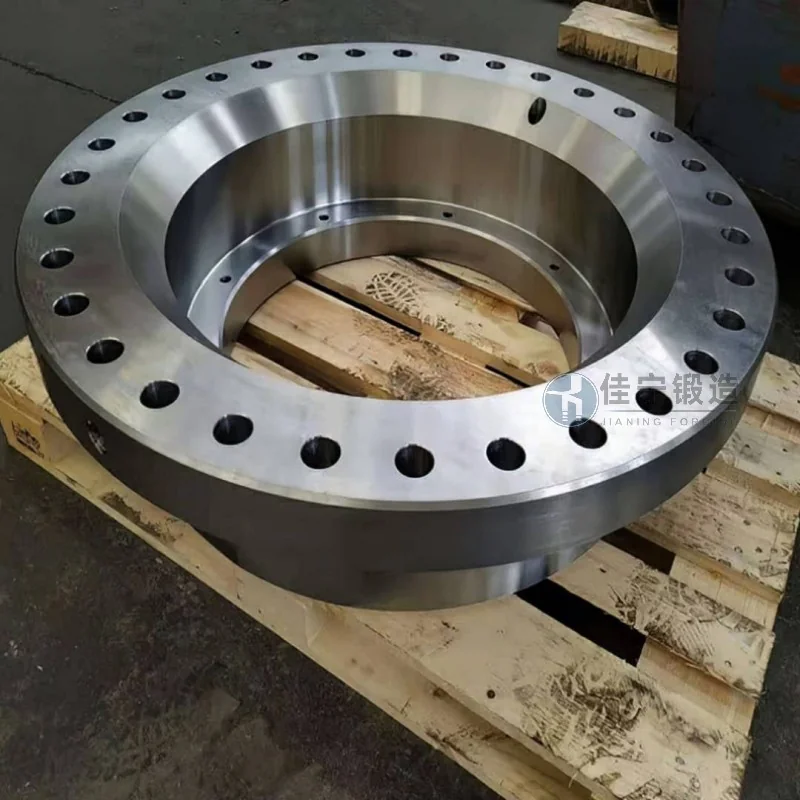
During the use of ring forgings, the wind power parts factory mainly encountered the following difficulties: First, poor dimensional consistency of forgings, with large deviations between outer and inner diameters between batches, requiring frequent adjustments in processing parameters; Second, microcracks or inclusions inside the material not only reduce the strength of key components such as flanges but also increase the failure rate of ultrasonic flaw detection; Third, supply cycles are unstable. Traditional suppliers struggle to coordinate raw material procurement and heat treatment, resulting in urgent orders being unable to be delivered on time. These issues directly increase the factory's rework costs and affect the trust of downstream customers.
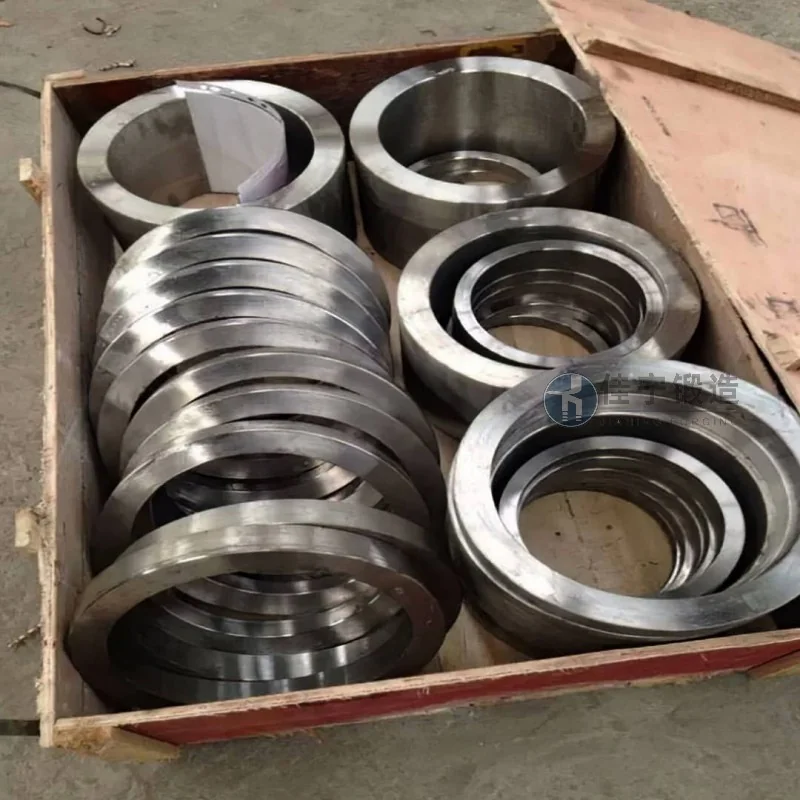
To address these pain points, Jianing Forging offers systematic solutions from three aspects: raw material control, forging processes, and heat treatment. At the raw material level, strictly selected alloy steel billets are used to stabilize chemical composition, and ultrasonic testing is performed individually to reduce defect risks from the source. In the forging stage, multi-directional forging and fine ring rolling processes are applied to make the metal flow line distribution more reasonable. At the same time, combined with CNC lathe machining, the dimensional tolerance of ring forgings is controlled within ±1 millimeter. In terms of heat treatment, a dedicated normalizing + tempering curve is designed to eliminate internal stress and refine grains, resulting in uniform overall hardness and improved fatigue resistance. In addition, Jianing Forging has established a flexible production scheduling system that can reduce the delivery cycle for regular orders to under 15 days, and urgent orders can be delivered in as fast as 7 days, strongly supporting the plant's production plans. After practical application, the first-pass pass rate of ring forgings at this wind power parts factory increased from 76% to over 95%, the processing scrap rate dropped significantly, and overall manufacturing costs were reduced by about 12%.