Shanxi Jianing Forging has gathered real-world cases of wind power flange rings, ring gears, bearing rings, roller rings, and other ring landings, with a complete range of finished forging products for carbon steel, stainless steel, and alloy rings, providing reference for product selection and non-standard solutions.
A building materials machinery factory in Linyi, Shandong, has long been limited by quality fluctuations and supply cycles of ring forgings when producing large slewing equipment. The forgings previously used by the company had issues such as uneven internal structure and large deviations in end-face parallelism, resulting in frequent rework during assembly, accelerated equipment wear during operation, and high maintenance costs. At the same time, supplier delivery cycles can reach as long as 45 days, seriously affecting production scheduling.
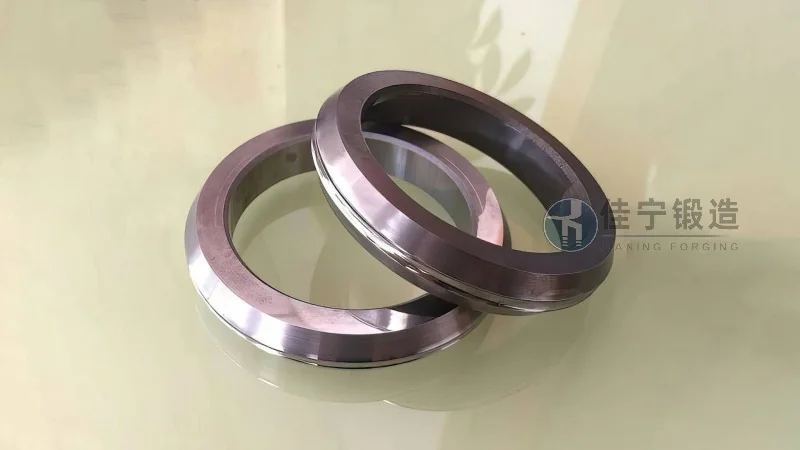
The customer's core pain points focus on three aspects: First, the high internal defect rate of forgings, with a flaw detection pass rate of only 78%, affecting equipment safety; Second, dimensional tolerance control is unstable, especially the concentricity deviation between the outer circle and inner hole often exceeds 0.5mm, resulting in uneven machining allowances in subsequent processing; Third, supplier capacity is insufficient, making it difficult to meet the flexible needs of small batches and multiple specifications.
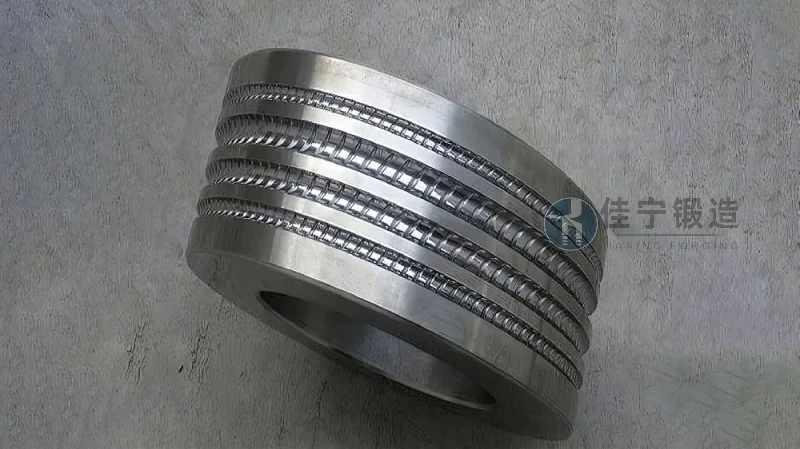
Jianing Forging addressed this customer's pain points by providing customized ring forging solutions. By optimizing the ingot billet opening process and multi-directional forging technology, casting looseness is effectively eliminated, increasing the internal density of the forging to over 98%, and maintaining a flaw detection pass rate of over 95%. In terms of dimensional control, fine ring rolling equipment combined with an online dimensional monitoring system is used to keep the outer diameter tolerance within ±0.3mm, and the end face parallelism reaches 0.15mm/m. At the same time, relying on our own forging production lines and flexible scheduling mechanisms, we shorten routine delivery cycles to 20 days, and urgent orders can be compressed to 12 days, supporting continuous production for customers.